Truck Types
Dry Van
Dry Van
Dry Van
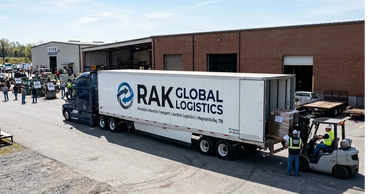
A dry van is primarily used for hauling "dry" palletized goods, boxed freight, and non-perishable consumer items that require protection from weather and road debris but do not need temperature control. In an industrial or auction setting, they are the go-to choice for transporting smaller machine parts, specialized tooling, electrical components, and warehouse supplies that can be easily loaded via a forklift from a standard loading dock. Because the cargo is fully enclosed and can be sealed, it is the standard for securing high-value loose items that aren't suited for an open-air flatbed.
Reefer
Dry Van
Dry Van
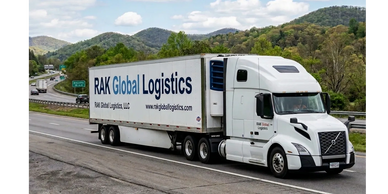
A reefer semi, short for a refrigerated semi-trailer, is primarily used to transport perishable goods that require strict temperature control throughout their journey. Unlike standard dry vans, these trailers are equipped with an active cooling unit—usually mounted on the front—to maintain a specific climate, whether it needs to be deep-frozen, chilled, or simply kept at a steady room temperature. While they are most commonly associated with hauling fresh produce, dairy, and meats from farms to grocery stores, they are also essential for moving sensitive medical supplies, pharmaceuticals, and even certain high-end electronics or chemicals that would degrade if exposed to extreme heat or cold.
Flatbed
Dry Van
Hot Shot
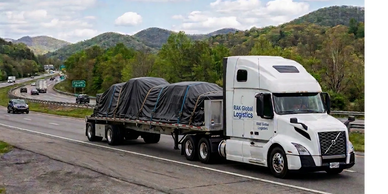
A flatbed semi, like the one depicted in the image, is a type of semi-trailer designed specifically for transporting large, heavy, or irregularly shaped cargo that cannot be easily loaded into an enclosed van. Characterized by its open, level deck with no sides or roof, it provides a versatile platform primarily used for carrying industrial and construction materials such as steel beams, lumber, large machinery, and concrete components. The open design allows for crane or forklift access from any angle, making the loading and unloading of cumbersome freight more efficient. In addition to general construction loads, flatbeds are essential for moving specialized equipment, industrial components, and, as seen in the photograph, even covered industrial machinery parts that require secure, accessible transport across the highway infrastructure.
Hot Shot
Live Bottom
Hot Shot
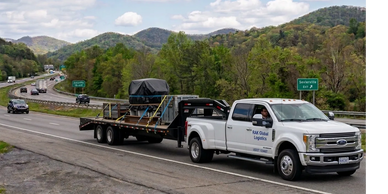
A hot shot truck typically consists of a heavy-duty pickup—most commonly a Ford F-350 or Ram 3500—pulling a gooseneck trailer to transport smaller, time-sensitive freight. Similar to the flatbed semi in the image, hot shot trucks are used for hauling irregularly shaped and uncontained cargo like construction equipment, industrial machinery, steel beams, and large crates. Because they use smaller vehicles and often smaller, single-vehicle operations, they are prioritized for expedited, direct-to-destination deliveries, filling the gap for loads that require flatbed versatility but are too small to justify the cost or slower scheduling of a full Class 8 tractor-trailer.
Live Bottom
Live Bottom
Live Bottom
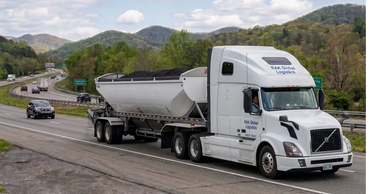
A live bottom semi, is an enclosed trailer primarily used for hauling loose, bulk materials that must be unloaded rapidly and evenly, such as gravel, asphalt, or grain. Instead of relying on a crane, forklift, or gravitational dump mechanism, the entire floor of the live bottom trailer consists of a powerful, hydraulically driven conveyor belt system. This mechanism "pushes" the material out of the rear gate at a controlled, uniform rate while the truck remains level and stationary. This controlled discharge is essential for preventing material segregation and providing precise, measured delivery—crucial for road paving or industrial operations. As illustrated in the image, the enclosed, aerodynamic design protects the material from the elements during transit, while the absence of a tilting dump body enables safe unloading even on uneven terrain or in low-clearance areas, where traditional dump trailers might be restricted.
LTL
Live Bottom
Live Bottom
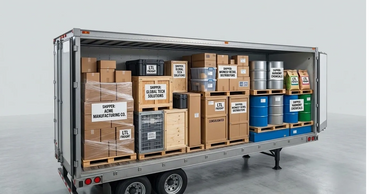
LTL, or Less Than Truckload, is a shipping method used for relatively small freight that does not require the full space of a semi-trailer. In this model, multiple shippers share space on the same truck, paying only for the portion of the trailer their cargo occupies. The process typically involves a "hub-and-spoke" network where shipments are collected from various locations, consolidated at a central terminal, and then redistributed to their final destinations. This is a cost-effective solution for businesses that move palletized goods but don't have enough volume to fill an entire 53-foot trailer.
Overseas Container

A dry van is primarily used for hauling "dry" palletized goods, boxed freight, and non-perishable consumer items that require protection from weather and road debris but do not need temperature control. In an industrial or auction setting, they are the go-to choice for transporting smaller machine parts, specialized tooling, electrical components, and warehouse supplies that can be easily loaded via a forklift from a standard loading dock. Because the cargo is fully enclosed and can be sealed, it is the standard for securing high-value loose items that aren't suited for an open-air flatbed.